As Your Resource For Self-Development
- The Optima Bowling Coach (2025)
Bowling Coach-Play Clinic
(Page Created 6/17/19 Update 2/9/26)
Inside the Optima Bowling World, the Bowling Coach-Play Clinic represents a practical experiment in dissolving the traditional coach–athlete divide. Rather than treating coaching as an external authority acting on a performer, this page explores a hybrid coach-play perspective, in which research, learning, and performance are initiated from within the individual and supported, rather than controlled, by others.
This clinic is not a product, program, or event. It is a developmental environment designed to make visible how self-authorization, perceptual control, and lifespan performance operate under real conditions.
From Coach-Athlete to Coach-Play
For much of modern coaching history, performance problems have been framed as behavioral deficiencies observed and corrected by an external authority. Within that framing, the athlete is acted upon; the coach acts. The Coach-Play perspective dissolves this polarity.
Here, the performer is understood as a living control system that actively regulates perception, reorganizes intention, and learns through experience. Coaching shifts from behavior correction to developmental accompaniment, where inquiry replaces instruction and dialogue replaces compliance.
The phrase "coach-play" signals a single integrated role: one who learns while guiding and guides while learning.
Performance as the Way of PIE
Within the Optima Bowling World, performance is understood as the Way of PIE:
- Purpose: the reference perceptions that orient action
- Integrity: the coherence of perception across conditions
- Experience: the corrective information supplied by action
The Coach-Play Clinic operates by making these elements explicit and workable. Participants do not attempt to control behavior directly. Instead, they research how purpose shapes perception, how perception organizes action, and how experience feeds back into learning, by reframing practice from mechanical drills to a study of oneself in motion.
From Ignoring Worlds to Working Upon Worlds
A central movement within the clinic is the transition from ignoring worlds to working upon worlds. Most performance environments focus narrowly on visible outcomes while ignoring the layered worlds within which those outcomes arise. The Coach-Play Clinic expands attention across four interrelated domains of self-consciousness development:
- Visible–Physical
- Physical–Etheric
- Emotional
- Mental–Causal
Learning accelerates when performers recognize which world is currently governing their perceptions and which world requires development. This awareness cannot be imposed. It must be discovered through self-research.
LPPC as the Governing Architecture
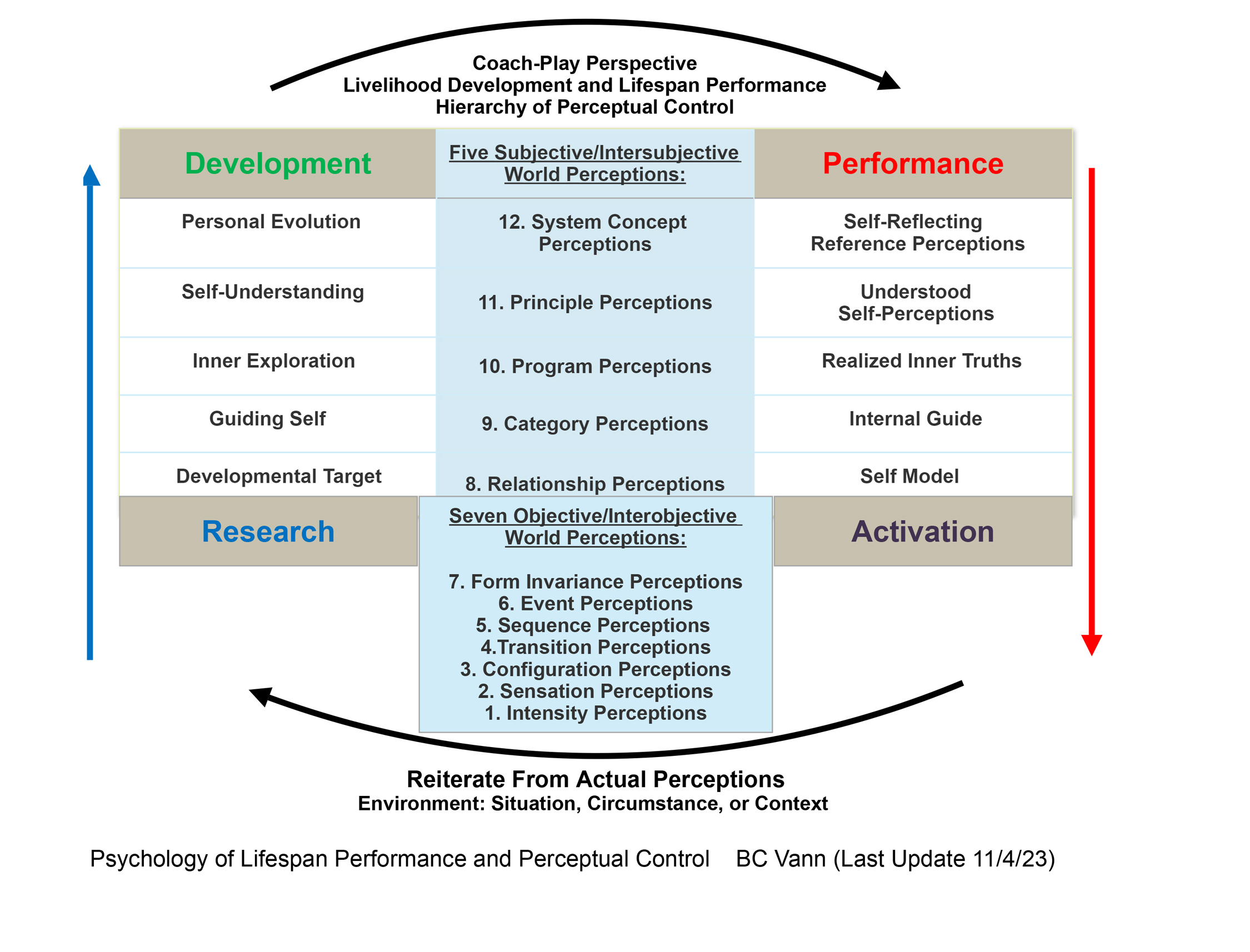
The Psychology of Lifespan Performance and Perceptual Control (LPPC) provides the clinic’s structural backbone. Rather than prescribing behaviors, LPPC tracks how reference perceptions are formed, tested, and reorganized across time. Within this architecture, we find: Research for development establishes or revises reference perceptions. Performance activation tests those references in live conditions. Feedback reveals coherence or conflict. Reorganization occurs naturally when an error persists.
The Coach-Play Clinic makes this cycle explicit and experiential, allowing participants to observe their own learning mechanism in real time.
Performance Authenticity Phases
The clinic environment is organized around four phases of performance authenticity, reflecting increasing levels of self-authorization:
- Pedagogy: externally directed learning
- Andragogy: self-directed learning with guidance
- Heutagogy: self-determined learning
- Self-Authorization: internally governed performance optimization
Participants are not forced upward. They are matched appropriately, ensuring that learning conditions respect developmental readiness rather than aspirational identity. This matching is essential. When mismatched, performers either disengage or become dependent. When aligned, learning becomes self-propelling.
Virtual Hypothetical Necessity
The Bowling Coach-Play Clinic is intentionally presented as a virtual, hypothetical environment. Its value lies not in the requisite physical infrastructure of the control-of-behavior theory. But in terms of conceptual clarity, that challenges performers and coaches alike to test whether they are willing to adapt to the practice of behavior as the control of perceptions. And operate from inquiry of real-time control and prepare to take responsibility for their own development.
In this sense, the clinic's service functions as a developmental mirror.
Implications for Coaching Practice
From a Coach-Play perspective:
- Clinics cannot be one-coach-fits-all.
- Developmental separation matters.
- Authority must be earned through coherence, not position.
- Community of practice replaces hierarchy.
When these conditions are met, coaching becomes collaborative research rather than corrective oversight.
Reflection Prompt
Consider a recent learning environment you participated in. Were you primarily being corrected, instructed, or invited into inquiry? Notice how that difference shaped your engagement, responsibility, and growth.
Back To: Teacher Student Relationship
Author Bio

Bruce Vann is a retired USBC silver-level coach and certified corporate performance coach who uses bowling as a lens for lifelong human development. His work draws on decades of experience in athletics, competitive bowling, mentoring, and coaching, including league, tournament, and the West Coast senior tour. Honor scores: 300 game and 834 series. He publishes his methods and ideologies in human development on OptimaBowling.com. The work began with a question he asked in 1968 that still guides him today: What the hell is wrong with this crazy world of ours?
See More: About-Me