(Page Update 12/30/25)
I did not set out to create a model of human development. What I was trying to do, over many years, across different contexts, was learn how to live sanely and responsibly in a world that often feels disorienting, reactive, and fragmented. I needed a way to understand my own experience clearly enough to act without losing integrity, and to keep learning without becoming cynical or paralyzed.
Over time, a pattern began to reveal itself. Not as a theory, but as a rhythm I could observe in real situations: in sport, in work, in learning, in relationships, and under pressure. Each time I made genuine progress, it followed the same sequence: Clarifying what mattered, widening perspective, testing understanding in experience, and taking responsibility for what I now understood.
The Cycle of Conscious Performance is a name for that recurring structure. It is not presented here as something to adopt or believe in. It is offered as a way to recognize what may already be happening in your own life, often quietly over time. What follows is an attempt to describe that cycle clearly enough that it can be studied, worked with, and lived, without losing contact with reality.
At certain moments in life, something shifts; it’s subtle, difficult to understand, tenuous, and insubstantial, leaving one in a seemingly precarious situation, and questions form about one’s suddenly insecure future path. The familiar pace of living begins to feel mismatched with the depth of experience unfolding within. The world seems louder, faster, and more insistent, while our sense of orientation struggles to keep up, becoming more of a disorientation. People describe this tension in many ways, but basically as restlessness, confusion, and disconnection. I’m thinking that each description points to the same condition: human civilization has not yet developed an inner coherence to meet the complexity as experienced. More difficult still is that, as individuals, when a bit of cohesion does materialize, it raises a question beyond the reach of mainstream philosophy and psychology. So, with that, how then does a human being learn to perceive the structure of their own consciousness in a way that is usable, stable, and true to life itself?
Understanding in the context of this essay is not agreement, not recognition, not tidy ideals. But in the spirit of life, the precise movement in which consciousness sees a matter clearly enough to work it out. In principle, this kind of understanding is always particular. One does not “understand life” in general. One understands a tension in action, a shift in emotional tone, a repetitive confusion, a pattern of attention, a developmental need. Most importantly, then, the sensible question to ask is why? Why is understanding seemingly always tied to intelligence and the matter at hand, becoming real only when the inner movement of comprehension meets the outer movement of observation?
The Cycle of Conscious Performance is built around this principle, described further through the four movements driving the development of consciousness: Purpose → Shared Learning → Lived Experience → Ownership. These movements form a cycle not because life repeats itself, but because human development is rhythmic, systemic, and hierarchical. Each movement reveals a specific kind of understanding:
When these movements operate together, understanding becomes coherent, not emotional comfort, but structural clarity. A steady relation between the inner observer and the outer world. Most people lack intelligence beyond discursive-inference thinking and principle thinking; thus, they are barely getting by without perspective thinking and systems thinking levels (I will not include causal intuitive thinking, but without that one either). One reason is that perspective thinking is not inherited. It must be developed. We come into life shaped by countless influences: family, culture, history, reactive patterns, and unfinished development from earlier evolutions. Without perspective, we move through life as if through fog, mistaking inherited reactions from animals and vegetation for inner truth. What looks like failure is simply being stuck in human potentialities that are not being worked through to actualization. We could say that is why this world of ours is crazy. If that is not the only reason, it certainly must qualify as the most influential reason. The explanation is simple: Craziness results from being trapped in human potential while ignoring the need to develop the three dimensions of being human. Ask around, and you’ll find that most humans don't know anything about the levels they are supposed to be working on (physical, emotional, and mental).
The purpose of the work that led me to the Optima Bowling 2026 Iteration was to help humanity overcome our history of disorientation. So a list of what to think is not appropriate. The approach is to meet others where they stand and talk about experience structurally, consciously, and integrally. Then, while we pay attention to inner movements with care, a different kind of clarity emerges, one that does not rely on belief or authority. Those two approaches are replaced by direct perception of how consciousness functions.
I have researched this for my development. And it is offered here as a resource for your development. By meeting you where you are standing, not as doctrine or as instruction. But as a natural cyclical, rhythmic, systemic perceptual orientation presented as movements through four interrelated sections. The energy felt from the Optima Bowling website is reflective, calm, grounded in lived experience, and aligned with the quiet discipline of self-research for livelihood development. From this approach, development becomes an aspiration, a practice of perceiving consciousness with increasing precision, gaining coherence that does not depend on circumstance, and works within any environment, situation, context, and/or circumstance. The cycle begins by working on learning how you think and how consciousness attends to its own experience.
From the legitimacy and necessity of human development, the cycle of conscious performance operates, not as an abstraction, but through four specific motions of consciousness that shape human life. These motions are not invented; they are observable, and when life is studied carefully enough, the same patterns or structures appear again and again. So, our conversation now shifts to how consciousness develops through four movements, each producing its own unique form of understanding at one of four levels: directional, perspectival, experiential, and integrative.
The following four movements of the Cycle of Conscious Performance form the backbone of the Optima Bowling 2026 Iteration. They appear in learning how to think, in reflection, in skill acquisition, in relationships, in personal evolution, and in the gradual formation of character, as the quiet architecture underlying human development.
Purpose is the movement that clarifies what we are trying to see. Every developmental act begins with a purpose beyond ambition and desire that instead pulls one toward what to think. The discovery of purpose is related to the opposite: a reorientation toward learning how to think. Thinking is an essential function and the first step in the development of human consciousness. When people are trained only in what to think, their minds borrow conclusions from their feelings, groups, or idols; when they learn how to think, perception stabilizes as they sense that chaos begins to sort itself into patterns in one’s awareness. How to think is not a style preference; it is a control function that allows consciousness to examine its own contents, to observe, differentiate, relate, and integrate until one’s intelligence becomes dependable. Learning how to think is the first essential discipline of a controlled life and a substructure that forms the basis of the Cycle of Conscious Performance.
Purpose, as used here, is the movement that aims at consciousness. It provides direction for attention, before any insightful idea is possible. When the purpose is vague, understanding remains vague. When purpose is clearly formed from an integrated intelligence (levels of thinking), consciousness gathers around the matter at hand. Purpose does not solve anything; it defines the field of inquiry. It opens the first pathway toward clarity by setting the condition for its specific kind of understanding: Directional Understanding, the sense of what one is looking for and why. In the context of self-development, this may sound simple, but purpose is the requisite and the causal reason behind self-research, which is the seed of coherence in the later movements. Purpose must be well thought through.
Shared learning is the movement that widens perspective beyond what a lone individual can see from their limited point of view. There are misunderstandings and misinterpretations. One’s consciousness has been shaped by its current level of development, so, as the saying goes, we see only from where we stand. Shared learning, the movement expressed in dialogue, community of practice, and perspective exchange, widens the perceptual field of discovery. It reveals one’s blind intuition and opens dimensions of a matter that might remain invisible in isolation.
The shared learning movement produces a second form of understanding, Perspectival Understanding, the insight that only arises through relationships. It is not about instruction. It is about placing consciousness in conditions and situations where perspective naturally expands. No one can develop fully alone. Consciousness is refined through contact (personal-physical or physical-publication), which also quickens one’s learning of how to think.
The movement of experience grounds insight in daily life. If an insight (purpose) never reaches experience but remains in the path of human potential as a quality not yet actualized, it will at times lead to the emotion of craziness. Human development becomes stable only when it is lived, when the shaping of consciousness is seen in one’s intentional actions, felt in one’s emotional tone, and/or experienced in one’s response to ideas about daily matters.
The understanding embodied in experience is experiential understanding, of knowing a matter through how it changes the way we meet other situations. If one’s intelligence is at a level below perspective thinking (usually developed within the shared learning movement), Experiential Understanding will not arrive in words, but with gestures, choices, habits, tensions released, reactions dissolved, and superficial iterations in actions quietly emerging. In other words, from a perceptual control perspective, the body and personality at times register and act mechanically before the mind fully articulates and controls behavior. Experience is not merely where development shows up; it is the laboratory through which development becomes real.
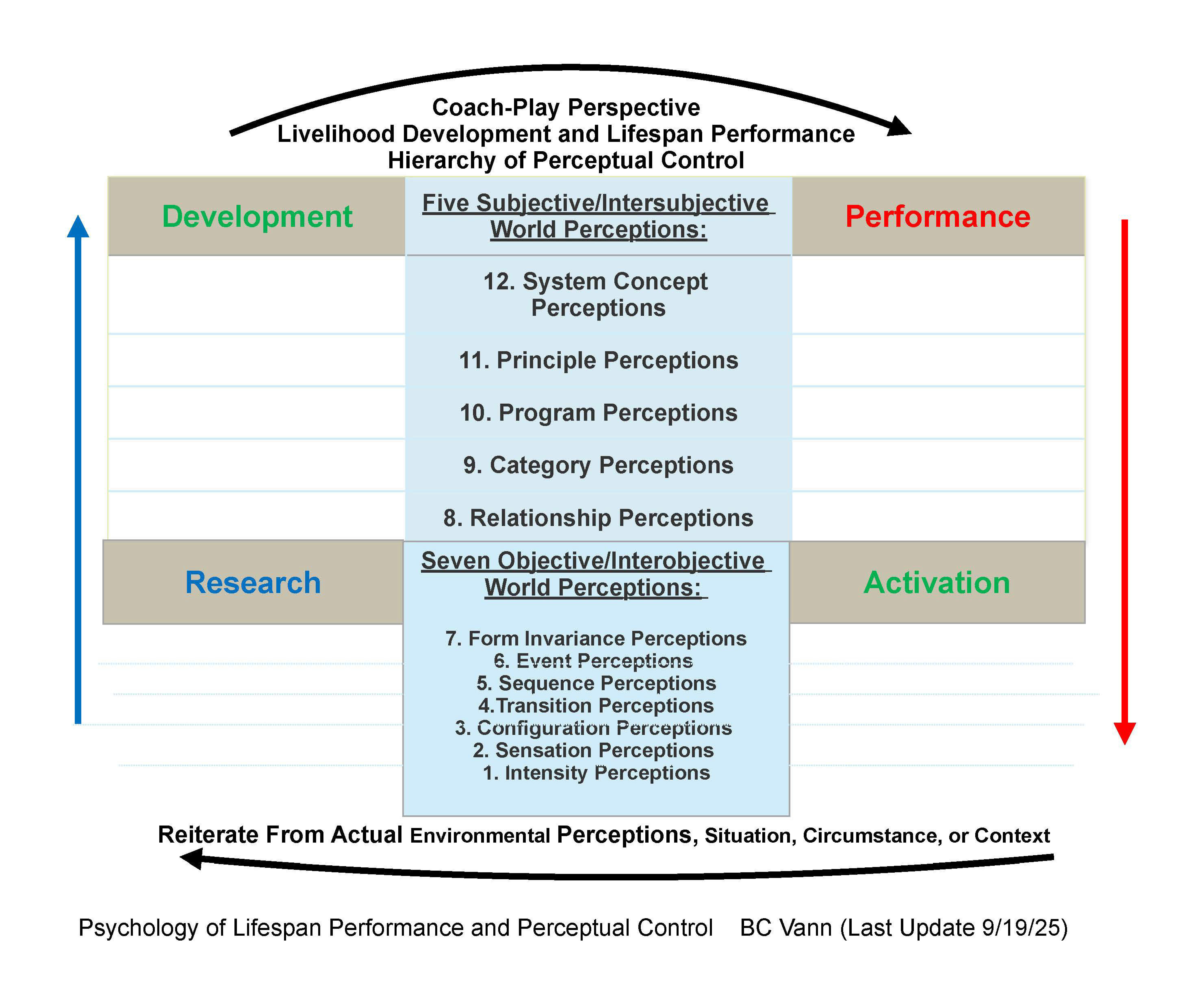
The movement of ownership stabilizes development into character. The final movement is ownership, not in the physical sense of will to power, but in the sense of responsibility for the integrity of the three dimensions of being human (physical-etheric, emotional repulse-attract, and mental-causal). Ownership is the process through which an understanding of certain matters becomes part and parcel of one’s research-to-activation structure (the LPPC model). Not something held temporarily, but that which is lived consistently.
The movement of ownership transforms sensible abilities and essential qualities into character by producing the fourth form of understanding, Integrative Understanding. The quiet clarity that comes from a lifespan of conscious performance, working countless life matters toward the activation of conscious stability.
Ownership is not dramatic. It is the unpretentious recognition and self-realization that one’s inner state, actions, and revised directions are no longer accidental. A person begins to act from an integrated understanding of life rather than reactions and maintenance of superficial matters. The internal noise quiets, the connection between intentions and actions strengthens, and conflicts are almost nought. Ownership completes the cycle of what you are currently working on and the movement that begins from where the next one pulls on you.
When these four movements operate together, they form a self-reinforcing rhythm. (1) Purpose aims consciousness. (2) Shared learning expands it. (3) Experience grounds it. And {4) Ownership stabilizes it. Then, when one enters the cycle again, it is with a slightly higher level of development, a slightly expanded perspective, slightly more integral coherence, and a slightly shinier character.
Over time, this rhythm becomes the backbone of a life lived with greater control of perceptions, dissolving superficiality by replacing it with structure and depth, turning disorientation into orientation, and developing capacity as both participant and observer of conscious performance in action and in rest. We find consciousness refining itself through its own energy, with each cycle, however short, contributing to the larger work of human development, one individual at a time. That gradual movement away from the stimulus-response reactive life in your past, toward a coherent understanding of the need for the highest level, the human development finality: the will to unity.
If the four movements describe how consciousness develops, self-research describes the activation of those movements. It is the quiet discipline of observing one’s own experience with enough care, integrity, and steadiness that the structure behind our actions begins to reveal itself. Self-research is neither inward retreat nor psychological analysis. It is the simple act of studying life as it is lived through actions, emotions, and thoughts, leading to motives, tensions, and choices, with the intention of perceiving the fine details.
Self-research is the activating force of the entire cycle of conscious performance. Without self-research, (1) purpose becomes wistful or wishful, and from that emotional stance, (2) shared learning becomes passive, (3) experience becomes mechanical, out of control, repetitive, and (4) ownership never stabilizes. But when one reenters the cycle from a self-research perspective, one’s purpose becomes a study of life as it is lived; the purposeful direction formed will be more to the point, and each subsequent movement will then easily become integral to the way of human development.
Self-research is the engine of the developmental cycle of conscious performance. Self-research begins with a particular kind of attention and intention: to see one’s inner movements with precision, without the judgment and avoidance we are all familiar with. Attention and intention together produce a specific form of understanding, working in conjunction with directional understanding, the understanding of inference thinking, the clarity of focusing on what is happening around us as it happens.
At first, it is modest, a fleeting recognition of a reactive pattern, a subtle noticing of emotional strain, a small shift in how one interprets a moment of conflict. Over time, as these small recognitions accumulate and the observer within becomes more stable, consciousness begins to witness its own activity, not from detachment, but from ground to consequence. Self-research reveals that much of what we call personality is simply habit, momentum, and inherited, unintentional mechanical patterns. If these patterns could be perceived clearly and not condemned, but understood in context, they lose their hold. We gain a sense of direction around the need to learn how to think, which becomes the first step in the self-research movement, as the research and study of intelligence levels.
Coherence is often misunderstood as a mood, a feeling, or a temporary state of alignment. But in the context of human development, coherence is a developmental achievement, structurally, systems thinking, and a condition of the work that leads to integration of the mental, emotional, and intentional rhythms. As one begins to notice the harmony of a clearer self-orientation initiated during self-research. And the first step to the research and study of intelligence. We realize that coherence is not given by life but develops through levels of thinking (1st). Then, in the second step, the cycles of understanding (directional, perspectival, experiential, and integrative) reveal that each of the four cycles contributes something subtle but essential.
At this point in one’s development, having understood the shift in how conscious performance organizes itself, they become less scattered, less reactive, and less easily disoriented by circumstances beyond their control; they begin to act from a conscious center rather than from unintentional mechanical habits or external pressures. Their decisions carry less noise and more simplicity. Their emotional life follows the queue created by the newly integrated intelligence, becoming less disturbing; their thinking becomes elevated and more discerning, and their actions more often intentional.
This coherence is not about a state of ease or comfort. It is orientation, the ability to sense where one stands and why. Coherence is the foundation one develops to carry them through the four levels of understanding. By creating the conditions within which consciousness works with rather than against itself.
Now, in step three, with coherence stabilized, a new sequence unfolds. It is not dramatic, but it is unmistakably sensed. In step two, perspectival understanding deepened the ability to sense matters from multiple angles, to understand the roots of tension, to recognize intended and unintended consequences of actions, and to interpret and experience without distortion. From perspective thinking, inference and principle (law), not as sentiment and commandments, but as the recognition of the underlying rhythm of life, one begins to sense continuity rather than fragments, patterns (regularities that matter) rather than episodes. Experience operating from the perspective level of intelligence, now, from this three-fold thinking (discursive-inference, principle, and perspective) comes maturity, the quiet, natural steadiness that appears when a person no longer relies only on discursive-inference thinking (from ground to circumstance) to control their inner state.
Maturity is not measured by age; it is the integration of the four levels of understanding with character, driven by the four levels of knowledge with the four ever-higher levels of intelligence. We see that there is no way around the First Essential of Human Development: Learning How to Think, also known as the will to reason. Learning to think is sensed and developed through repeated cycles of conscious performance and the input of knowledge from one’s self-controlled environment.
Here we reach out with step four. While the Optima Bowling narrative is personal, its significance is not merely individual. Each person who gains coherence contributes something to the collective as a profound, subtle, stabilizing influence that supports the possibility of clarity in others. The world feels disoriented not because systems are failing, but because humanity as a collective is ignoring the three steps presented above; as a result, most people live superficial lives.
Step four, the task laid out here, is not for the perfection of society, but to transition from the busyness of superficiality to clearer, more mature forms discovered during one’s conscious performance. Step four, as defined through an integrative understanding, is character development. Understanding stabilizes into character (sensible abilities and essential qualities), and serves as the gateway to collective evolution.
Humanity evolves one self-oriented soul at a time. By simply starting with step one: learning how to think, then with an intelligent orientation of life, participate in the slow movement of human conscious performance development toward clarity, connection, and unity. The study and development of intelligence becomes aspirational. It is the natural direction of human development, maturing through life after life. In this sense, the Cycle of Conscious Performance is not a theory. It is a description of how consciousness evolves, individually and collectively. And every person engaging in this work over a lifespan becomes part of that evolution.
Let’s walk through the structure of the Optima Bowling 2026 Iteration, following the process formed by the Cycle of Conscious Performance as the organizing principle, into four sections. Supporting each section is a corresponding movement of the cycle, offering a specific type of developmental engagement and a way to enter the work with a direct relationship to your current level of need and awareness. The four sections were not formed from a hierarchy, per se, but rather the resulting structure followed the natural rhythmic cycle of livelihood development and lifespan performance (LPPC model). You can begin anywhere; the cycle will meet you wherever you stand: Enter Through Purpose, Shared Learning, Experience, or Ownership.
The Purpose of Research section begins casually to clarify the life matters one is involved with, but it gets serious very quickly. The purpose of research flows from the purpose movement, which explains why self-research is clearly the foundation of human development and how directed attention shapes consciousness. This section highlights important destinations: learning how to think, forming directional understanding, and clarity about specific perceptions one is trying to control and why. The purpose of research is the point where one begins an inquiry into the reality of the two main areas of livelihood development: (1) the four levels of thinking that lead one toward integrated intelligence, and (2) integrity of the three dimensions of being human.
See More: Purpose of Research
The Collaborative Coaching Community of Practice, an approach grounded in dialogue, resolves misunderstandings of hybrid dichotomies, such as teacher-student, coach-play, or business-busyness. This section aligns with the shared learning movement through collective knowledge, beginning with the discovery, value, and application of perspective thinking. Here, conversational reflective dialogue with others and the collective’s broader understanding of human consciousness help reveal what may otherwise remain unseen. In this section, one works to cultivate a perspectival understanding of our hybrid nature, the insight that arises only when consciousness is placed in relationship. It is the movement that corrects blind spots and broadens perception through the study of certain published works and/or from person-to-person exchanges (analogue and digital).
See More: Collaborative Coaching Community of Practice
The Experience Human Development section grounds the cycle in the personal moments of one’s daily life. Here, in relation to the movement of experience, (1) we explore how development expresses itself through the practical matters of living: intended actions, emotions, and thinking. (2) Promote experiential understanding by knowing a matter because it has been lived, tested, and felt through the rhythms of ordinary life. And (3) attend to where the inner and outer dimensions of being human meet in support of one’s lifespan conscious performance.
See More: Experience Human Development
To be consistent with the movement of ownership, we find Control Your Life. This section’s focus is (1) individual awakening to stabilize understanding into character, to approach genuine ownership of one’s character development (sensible abilities and essential qualities). (2) The capacity of responsibility and integrity that works on life’s most pressing matters, with special attention to integrative understanding. (3) To transcend superficiality by operating in service to humanity, evolution, and unity in support of the self-research for livelihood development process. Ownership is both a culmination and the beginning. It completes the cycle and is prepared for another.
See More: Control Your Life
Underlying Optima Bowling, behind every page is a single stance: I have researched this for my development. Here it is, offered as a resource for your development. Which means, Optima Bowling is personal, my life presented as a historical autobiographical story, as well as an up-to-the-moment resource for the collective’s research project in continuum. This stance shapes the tone and voice, with no intention of portraying the roles of teacher or leader. No doctrine. No persuasion. Only shared research for development, everything is written from lived experience, tested through personal study, reflection, and the quiet discipline of observing consciousness in motion.
Reading this is neither instruction nor guide, but an invitation into a space where development becomes visible, comprehensible, and applicable for your work on specific life matters. In this sense, the website is not a collection of fragments. It could stand as a discovery of a new field of research based on my 1968 question: What the hell is wrong with this crazy world of ours? After 55 years of study, I did (2023) identify the solution, which I have since expanded and now present, with this, the Optima Bowling 2026 Iteration, as the resolution to our craziness, to share with the world. But it is not important to ask for any classification; it is merely another way to think about something humanity has been working through forever.
Every reader enters life at a particular stage of development, not by choice, but by the forces of evolution, inheritance, environment, situation, circumstance, and the context of previous experience. Most of us are disoriented and still working to form coherence, still learning to perceive life as a conscious performance. This is not a flaw. It is simply the developmental reality and history of humanity. The invitation of this website is simple:
If you do this, in your own way and at your own pace, you will participate in the broader evolution of a shared consciousness. Each person who gains coherence becomes a stabilizing force in humanity's consciousness. This influence is subtle but real. When studied, it is the quiet work that supports the future.
The Cycle of Conscious Performance is not a theory to adopt but a rhythm to recognize in one’s self-realization; consciousness does not leap over the will to power, will to love, will to reason to land magically on the will to unity. Each person must work on their integrity, growing toward it, one interconnected movement at a time.
The cycle of conscious performance never ends; one only enters again at the level in need, with slightly more clarity, slightly more coherence, slightly more capacity to understand life as a structured field of conscious performance rather than a confusing stream of events. This is the work of a lifetime, and of many lifetimes. It is the movement of an individual consciousness learning to understand itself, not through escape or abstraction, but through the real matters of being human. You are welcome to join that motion, in your own way, in your own time. The cycle is already running within your organism. Optima Bowling simply makes it visible.