As Your Resource For Self-Development
- The Optima Bowling Coach (2025)
Self-Control
(Page Created 3/28/20 Updated 2/9/26)
Inside the Optima Bowling World, Self-Control does not refer to discipline, restraint, or willpower. It identifies a structural reality in which control resides in human functioning. This page marks the point at which performance, coaching, and development can no longer be explained by external management or behavioral enforcement.
Self-Control emerges when authority moves inward, when individuals recognize themselves as the active regulators of perception, emotion, and action, particularly under pressure.
What Self-Control Is Not
Self-Control is often misunderstood as suppressing emotions, forcing compliance, exerting effort to “stay focused,” or overriding impulses through discipline.
These interpretations confuse behavioral inhibition with control. They treat control as something applied to the self rather than exercised by the self. From the Optima Bowling World perspective, such approaches generate tension rather than coherence. They may produce short-term orientation, but they fail when conditions become complex, unfamiliar, or emotionally charged.
Control Does Not Live in Behavior
Human beings do not control behavior directly. We control perception. Behavior is the means by which perceptions are aligned with internal reference values: what matters, what feels right, and what must be maintained. When perception aligns, behavior stabilizes. When it does not, effort increases, conflict emerges, or a breakdown occurs.
Attempts to control behavior without understanding perception result in:
- Overcorrection.
- Internal conflict.
- Dependency on external authority.
- Or brittle performance that collapses under pressure.
Self-Control begins with recognizing this fact.
Perceptual Control as the Missing Key
Perceptual Control Theory (PCT) clarifies the mechanism. Individuals act to reduce error between perceived experience and internally held reference conditions. When error persists, systems reorganize.
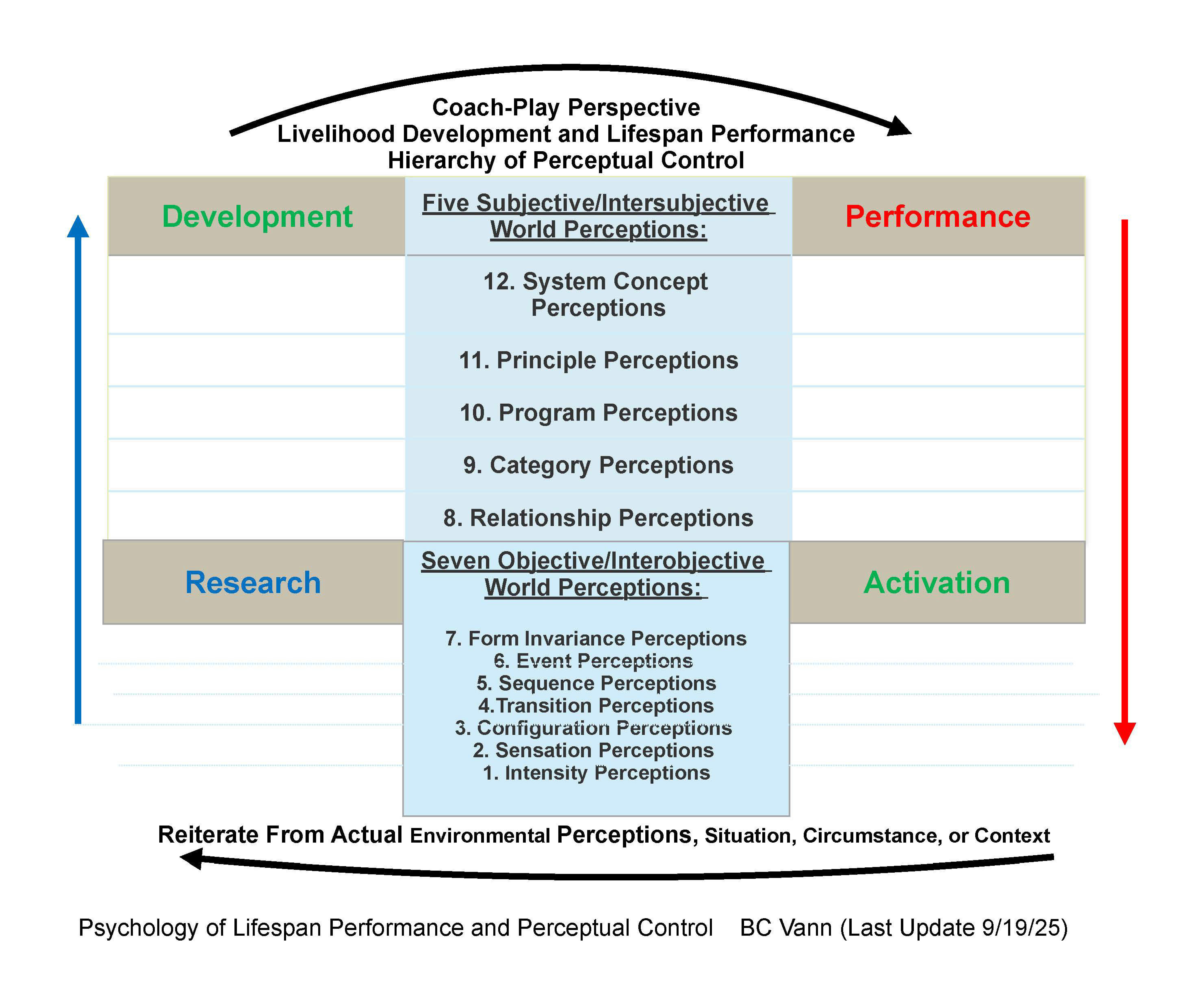
LPPC extends this understanding across time, showing that sustainable performance depends on how reference values are formed, tested, and revised across developmental planes. Self-Control is not learned through instruction. It is developed through self-research, the disciplined observation of one’s own control processes in action.
The Developmental Shift
Self-control becomes necessary when external feedback no longer resolves performance instability, motivation loses effectiveness, effort yields diminishing returns, or emotional reactions undermine execution. At this point, improvement cannot be imposed. It must be owned.
This shift does not eliminate the need for coaching or community. It changes the collective function, from correction to support for inquiry. The learner becomes responsible not just for behavior, but for noticing reference conflicts, interpreting emotional signals, and adjusting perception rather than forcing action.
Emotional Control Reconsidered
Emotion is not the enemy of Self-Control. It is information. Emotional intensity signals persistent perceptual error; something important is misaligned. Suppressing emotion removes the signal without resolving the cause. Amplifying emotion obscures clarity. Self-Control involves learning how to read emotional signals accurately, trace them to underlying reference conflicts, and reorganize perception rather than react impulsively.
When this occurs, emotional regulation becomes a byproduct of coherence, not a forced technique.
Self-Control and Responsibility
Self-control entails responsibility, but not blame. Responsibility here means recognizing that control cannot be outsourced, coherence cannot be enforced, and development cannot be rushed.
Blame collapses complexity into judgment. Responsibility expands capacity for adjustment. As Self-Control stabilizes, dependence on approval, instruction, and validation diminishes. Confidence becomes quieter. Performance becomes more reliable.
Relationship to Coaching
Self-Control redefines the coaching relationship. The coach is no longer the controller of performance. The coach serves as a mirror for perception, a partner in inquiry, and a stabilizer of learning environments.
Authority shifts from position to coherence. Trust replaces compliance. Dialogue replaces instruction. This shift is essential for collaborative coaching communities to function without hierarchy dominating development.
Reflection Prompt
Recall a moment under pressure when effort increased, but control decreased. Instead of asking what you should have done differently, ask what perception you were trying and failing to stabilize. That question marks the beginning of Self-Control.
Orientation Within the Back to the Beginning Pathway
This page addresses a concept that is often reduced to discipline, restraint, or willpower, but which functions at a much deeper level. Self-control, as used here, is not about forcing behavior into compliance. It concerns where control is organized within a person and whether that organization is capable of governing experience under real-world conditions.
Within the Back to the Beginning pathway, this page marks a turning point. After inner turmoil exposes the limits of inherited control strategies, attention naturally shifts toward understanding how regulation occurs from the inside out. What matters is not how much effort is applied, but which perceptions are being controlled, and at what level.
The pages linked below examine this question across practical domains where self-control is often assumed rather than understood. Each explores situations in which control is distributed across personal, social, and developmental contexts, revealing why stability cannot be sustained through effort alone. These pages do not offer techniques for managing behavior. They clarify the conditions under which control becomes reliable.
If this page resonates, the following pages offer places to observe how self-control develops as a functional capacity that emerges through organization and understanding rather than enforcement.
Related Pages:
- Humanity and Applied Research
- Research for Development
- Livelihood Development Phase
- The Livelihood and Lifespan Relation
Author Bio

Bruce Vann is a retired USBC silver-level coach and certified corporate performance coach who uses bowling as a lens for lifelong human development. His work draws on decades of experience in athletics, competitive bowling, mentoring, and coaching, including league, tournament, and the West Coast senior tour. Honor scores: 300 game and 834 series. He publishes his methods and ideologies in human development on OptimaBowling.com. The work began with a question he asked in 1968 that still guides him today: What the hell is wrong with this crazy world of ours?
See More: About-Me