As Your Resource For Self-Development
- The Optima Bowling Coach (2025)
The Livelihood and Lifespan Relation
Page Created 12/29/23 Updated 4/21/26)
Within the Optima Bowling World, the Livelihood and Lifespan Relation posits that livelihood development and lifespan performance interact through a cyclical, systemic, hierarchical process rather than through linear steps culminating in a higher-order human. Livelihood development is not something a person progresses through once and then leaves behind. It is a domain in which individuals repeatedly move between research and activation as their capacities, responsibilities, and contexts evolve over the course of a lifetime.
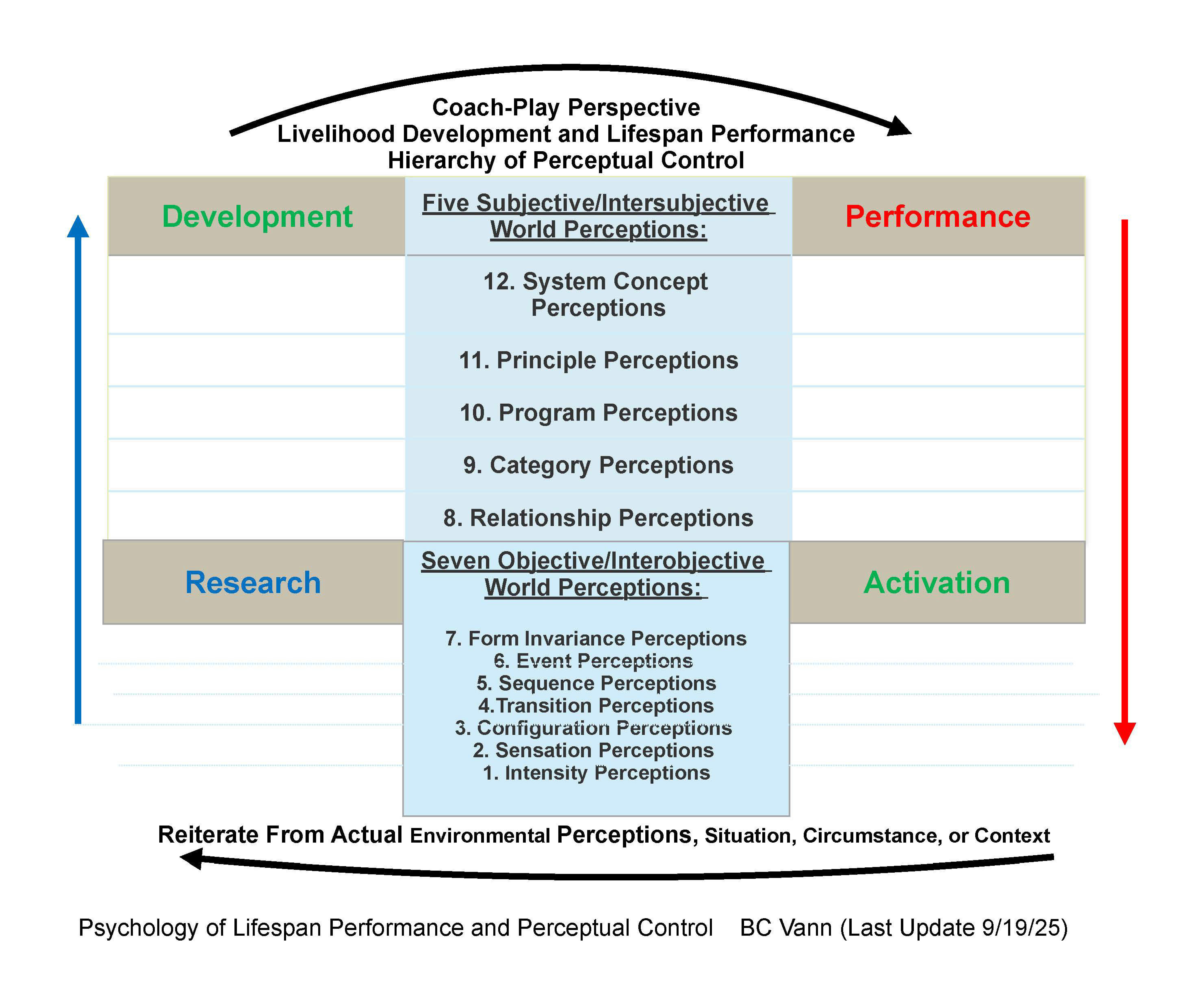
This page establishes the correct frame: livelihood development follows the same LPPC psychological mechanism that governs all conscious performance, an ascending movement of research for development, and a descending movement of performance activation.
Livelihood: A Cyclical Developmental Field
Livelihood occupies a central place in adult life because it continuously engages attention, responsibility, identity, and contribution.
As a result, livelihood is not developmentally neutral. It is the primary field from which conscious performance is either refined or constrained. The Optima Bowling World perspective holds that livelihood development advances through evolutionary stages by repeating the cycle between inquiry and enactment.
The Two Movements Governing Livelihood
Livelihood development unfolds through two complementary and recurring phases:
1. Research for Livelihood Development (Ascending)
In the research-for-livelihood development phase, attention turns upward and inward. Individuals begin to question what their work means, how responsibility is being carried out, whether effort and value remain aligned, and what no longer fits their current understanding.
Dissatisfaction for its own sake, it is not. It is a functional inquiry, the same ascending movement that is explicitly found in the LPPC model. Research becomes necessary when existing patterns of work can no longer support coherence.
2. Lifespan Performance to Activation (Descending)
In the descending phase, lifespan-performance-to-activation clarifies understanding in action. Here, livelihood, across a lifespan, becomes application, commitment, contribution, and embodied responsibility.
Activation does not mean mere productivity. It means implementing what has been clarified through research under real conditions over time. This movement anchors development in reality.
Why Livelihood Tension Arises
Livelihood tension does not mean something is “wrong with one’s career.” It arises when research is required but postponed, activation is demanded without renewed inquiry, or performance continues after meaning has eroded.
In each case, the problem is not the work itself but a misalignment of energy, intention, and attention toward the wrong LPPC phase at the wrong time. Understanding this prevents unnecessary self-blame and premature conclusions.
Lifespan Does Not Mean Linear Progression
Throughout a lifespan, individuals repeatedly cycle through these two phases. A person may be active in one livelihood developmental level, researching in another, or oscillating between the two as conditions change.
There is no final phase to reach, no permanent arrival point, and no universal timetable. What changes over time is the depth, scope, and responsibility carried through each cycle. Maturity expresses itself as the ability to recognize which phase is required at a certain moment.
Why This Is Often Misread
Many cultural narratives interpret difficulties in livelihoods as a lack of ambition, failure to commit, or a need for self-reinvention. However, in the Optima Bowling World, these interpretations misrepresent the mechanism.
Most livelihood distress reflects suppressed research, prolonged attempts at activation without renewed development, or external pressure overriding internal reference values. Once the correct movement is restored, development resumes without drama.
Coaching and the Livelihood–Lifespan Relation
Coaching that ignores this cyclical relation tends to push action when inquiry is needed, encourage reflection when commitment is required, or impose timelines unrelated to development.
Mature coaching recognizes livelihood as a living control process rather than a static identity. It helps individuals identify which phase they are in and supports them accordingly.
See More: Lifespan Performance Activation Phase
Back To: Self-Control
Author Bio

Bruce Vann is a retired USBC silver-level coach and certified corporate performance coach who uses bowling as a lens for lifelong human development. His work draws on decades of experience in athletics, competitive bowling, mentoring, and coaching, including league, tournament, and the West Coast senior tour. Honor scores: 300 game and 834 series. He publishes his methods and ideologies in human development on OptimaBowling.com. The work began with a question he asked in 1968 that still guides him today: What the hell is wrong with this crazy world of ours?
See More: About-Me