As Your Resource For Self-Development
- The Optima Bowling Coach (2025)
Livelihood Development Phase
(Page Created 1/4/24) Updated 2/6/26)
Within the Optima Bowling World, the description of the Livelihood Development Phase is not of a sequence of career stages completed in a single lifetime. It names the functional positions a person occupies as they cycle between research for livelihood development and lifespan performance activations.
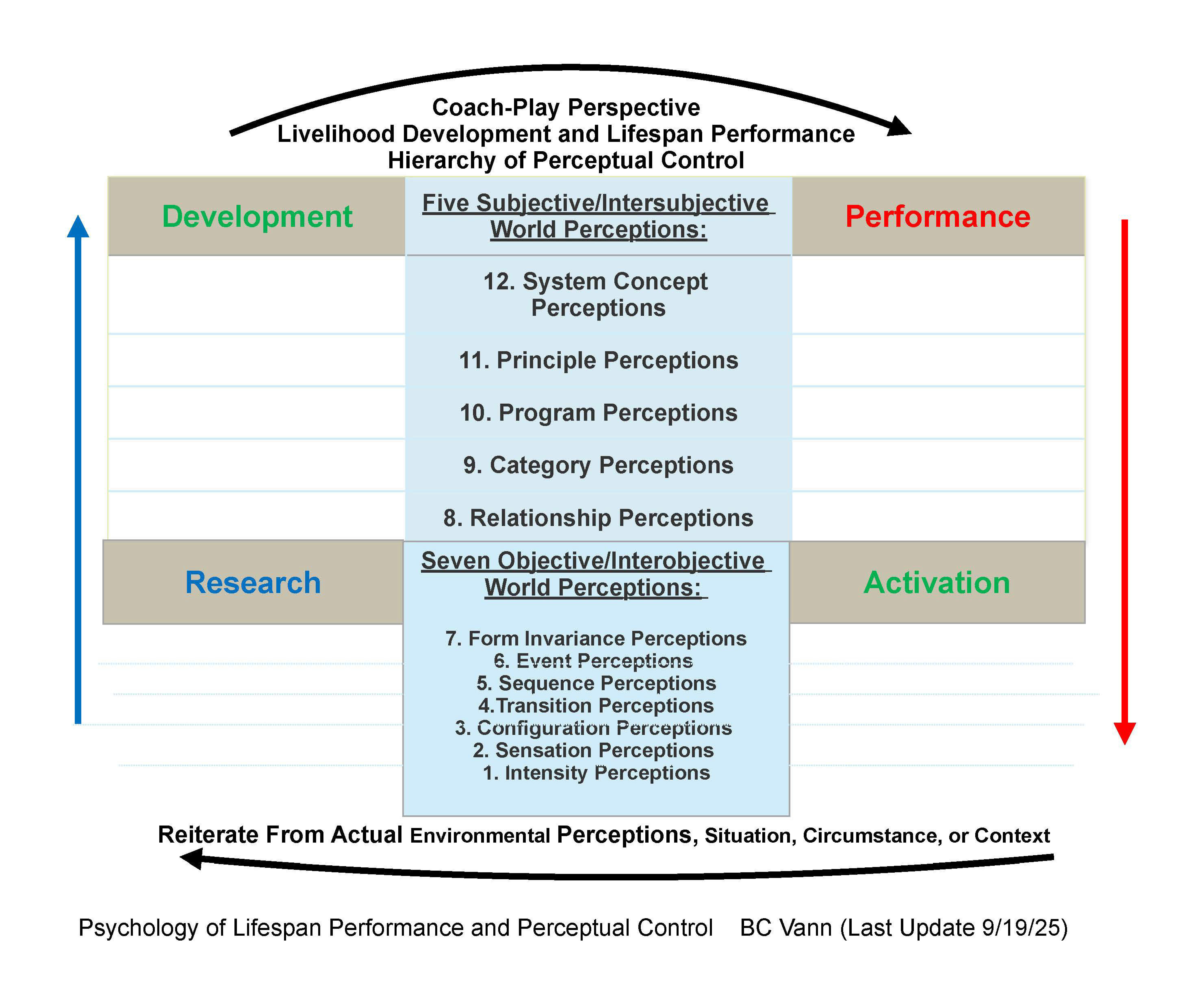
On this page, I've used LPPC to model how a livelihood alternates between research for livelihood development and lifespan performance activations of capacities, responsibilities, and evolving contexts.
Livelihood Development Is Cyclical, Not Sequential
A livelihood is not something a person advances through and leaves behind. It is a developmental field that continually re-engages the same underlying process of conscious performance.
Across the lifespan, individuals repeatedly return to questions of meaning, responsibility, contribution, and coherence in work. Each return does not indicate failure or regression. It demonstrates that new conditions now require a renewed cycle of development.
Two Functional Positions Within the Cycle
Rather than stages, livelihood development involves two recurring functional positions within the LPPC cycle. These positions are not fixed identities. They describe where attention and effort are currently required.
Position One: Research for Livelihood Development (Ascending)
In this position, livelihood becomes the object of inquiry. Attention turns toward examining whether current work still supports coherence, clarifying responsibility at a higher level, questioning assumptions that once worked but no longer fit, and reorienting purpose in light of lived experience.
This movement often appears when effort increases but meaning diminishes, performance remains competent but feels hollow, or responsibility expands beyond existing reference values. Research here is not dissatisfaction or indecision. It is a functional inquiry, required when previous patterns can no longer integrate experience.
Position Two: Lifespan Performance to Activation (Descending)
In this position, clarified understanding is carried back into action. Here, livelihood becomes the site of commitment, execution, contribution, and embodied responsibility.
Activation means living out what has been clarified through research, within real constraints, relationships, and consequences. This movement stabilizes development by anchoring insight in reality. Without activation, research becomes abstract. Without research, activation becomes mechanical.
Why Tension Signals a Required Shift
Livelihood tension arises when the wrong movement is being emphasized. Examples include: continued activation when research is required, prolonged research when activation is now possible, or external pressure forcing performance without renewed inquiry.
In each case, the issue is not the work itself, but misaligned movement within the cycle. Recognizing this prevents premature conclusions about career change, motivation, or identity.
Hierarchy Without Linear Ranking
The LPPC cycle is hierarchical in function, not in status. Higher-order subjective reference perceptions (e.g., responsibility, purpose, system concepts) guide lower-order objective reference perceptions. Still, they do not eliminate the utility of the latter during the early phase of research on livelihood development, especially when effective performance perceptions inform and reshape higher-order understanding.
Livelihood development depends on maintaining this hierarchy, rather than flattening it into permanent action or permanent reflection.
Repetition Across the Lifespan
Across a lifespan, individuals may research early and activate later, activate for years and then return to research, or cycle more frequently as complexity increases.
What changes over time is not the cycle itself, but the depth of inquiry, the scope of responsibility, and the scale of activation. Maturation is reflected in increased sensitivity to which movements are now required.
Common Misreadings
Livelihood development is often misread as career dissatisfaction, lack of ambition, fear of commitment, or restlessness.
From the Optima Bowling World perspective, these are surface interpretations of a deeper process. Most livelihood distress reflects blocked or suppressed cycling, not personal deficiency.
Coaching and Livelihood Development Phase
Effective coaching recognizes these functional positions. When research is required, the coach supports inquiry, protects uncertainty, and resists premature action.
When activation is required, the coach supports commitment, clarifies responsibility, and grounds insight in performance.
Coaching fails when it imposes one movement regardless of readiness.
Reflection Prompt
Notice where your livelihood currently feels strained or inert. Ask not what stage you should be in, but whether research or activation is now being asked of you. That distinction restores movement.
Back to: Self-Control
Author Bio

Bruce Vann is a retired USBC silver-level coach and certified corporate performance coach who uses bowling as a lens for lifelong human development. His work draws on decades of experience in athletics, competitive bowling, mentoring, and coaching, including league, tournament, and the West Coast senior tour. Honor scores: 300 game and 834 series. He publishes his methods and ideologies in human development on OptimaBowling.com. The work began with a question he asked in 1968 that still guides him today: What the hell is wrong with this crazy world of ours?
See More: About-Me