As Your Resource For Self-Development
- The Optima Bowling Coach (2025)
A Connected School
(Page Created 6/6/20 Updated 2/5/26)
Inside the Optima Bowling World, A Connected School refers not to technology, platforms, or institutional networking but to a developmentally coherent learning environment in which students, teachers, curriculum, and culture are aligned around how people actually learn and develop over time.
This page examines why many schools feel fragmented despite good intentions, and what becomes possible when learning is organized around connection rather than control.
What “Connected” Usually Means and Why It Falls Short
In contemporary education, “connected” often means digitally networked classrooms, collaborative tools, shared content platforms, or real-time communication systems.
While these tools can increase access and efficiency, they do not address the deeper problem. Many schools remain disconnected at the human level, even as their technology becomes more integrated.
- Students feel unseen.
- Teachers feel constrained.
- Learning feels transactional.
Connection, in a developmental sense, is something else entirely.
Connection as Coherence
From the Optima Bowling World perspective, a connected school is one in which learning activities connect to lived experience, authority aligns with developmental readiness, feedback supports reorganization rather than compliance, and purpose is visible rather than assumed.
Connection is not added. It is designed into the structure. When coherence exists, individuals feel oriented. When it does not, effort increases while meaning drains away.
The Cost of Fragmented Schooling
Fragmentation in schools appears in familiar ways: Subjects disconnected from one another, grades disconnected from understanding, behavior policies disconnected from development, teachers disconnected from decision-making, and students disconnected from relevance.
These fractures are not primarily moral or motivational failures. There are structural mismatches between how learning is organized and how human development actually works. A connected school addresses structure before blame.
Learning as a Control Process
Learning occurs when students reorganize their internal control systems, not when information is delivered. From a Perceptual Control perspective, students act to stabilize perception; confusion signals unresolved error; resistance often protects fragile control; and engagement emerges when reference values feel legitimate. A connected school designs learning environments that work with these processes rather than against them.
The Teacher–Student Relationship Revisited
In a connected school, teaching is not the enforcement of a curriculum. It is the stewardship of learning conditions.
- Teachers clarify purpose, introduce productive disturbance, and protect psychological safety for inquiry.
- Students gradually assume responsibility for their own learning as internal authority develops. Connection deepens as authority migrates rather than disappears.
This movement is intentional, not accidental.
Curriculum as a Developmental Path
Curriculum in a connected school is not a checklist. It is a developmental path.
- Concepts are revisited across time.
- Skills deepen through variation.
- Understanding accumulates through application.
Assessment shifts from ranking to diagnosis—revealing where control stabilizes and where it breaks down. Grades may remain, but they no longer define identity or worth.
Behavior, Discipline, and Belonging
Discipline problems often signal disconnection rather than defiance. When students feel unseen, over-controlled, or irrelevant to learning, attempts to intensify behavioral control escalate.
Belonging emerges from coherence, not enforcement, and is, in fact, why a connected school treats behavior as information. Instead of asking, how do we stop this? The question becomes, what is not connecting here and why?
Collective Control in Educational Systems
Schools are collective control systems. When purpose, norms, and feedback are aligned, coordination emerges naturally, conflict becomes workable, and learning accelerates. When alignment fails, policies multiply, supervision intensifies, and disengagement spreads quietly. A connected school focuses less on managing people and more on aligning reference values across the system.
Relationship to Character Development
Character need not be taught as a separate subject. In a connected school, responsibility develops through participation, integrity develops through coherence, and resilience develops through supported challenge. Character becomes a byproduct of developmental design rather than a moral campaign.
Reflection Prompt
Think of a school environment you experienced as meaningful. Notice what felt connected between subjects, people, purpose, and experience. That coherence, not the tools used, is what made learning possible.
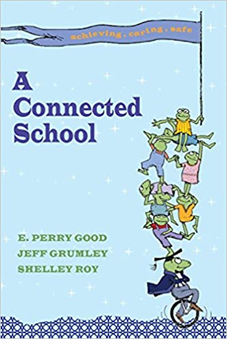
Resource: A Connected School (Reprinted June 2014) by E. Perry Good, Jeff Grumley, and Shelley Roy.
A Connected School shows you how to create a school climate that fosters achievement, caring, and safety for students, school staff, and the community. The book will introduce readers to Perceptual Control Theory to help educators interact with students in ways that foster students' internal motivation. We increase achievement by connecting to others, creating a safe and caring environment, and teaching in ways that promote students' innate desire to learn. The role of the Connected School educator is to help students understand how to become disciplined within and to create opportunities to do so in a non-coercive setting.
Back To: Researching Perceptual Control Theory (PCT)
Author Bio

Bruce Vann is a retired USBC silver-level coach and certified corporate performance coach who uses bowling as a lens for lifelong human development. His work draws on decades of experience in athletics, competitive bowling, mentoring, and coaching, including league, tournament, and the West Coast senior tour. Honor scores: 300 game and 834 series. He publishes his methods and ideologies in human development on OptimaBowling.com. The work began with a question he asked in 1968 that still guides him today: What the hell is wrong with this crazy world of ours?
See More: About-Me