As Your Resource For Self-Development
- The Optima Bowling Coach (2025)
Traditional Performance Management
(Page Created 8/31/19 Update 2/3/26)
Inside the Optima Bowling World, Traditional Performance Management is a widely adopted but developmentally limited approach to organizing human effort. It treats performance as something that can be controlled externally through standards, measurement, supervision, and compliance. While effective for coordination and short-term results, this model struggles when complexity, pressure, and individual development increase.
This page clarifies what Traditional Performance Management does well, where it fails, and why human development eventually requires a different orientation.
The Management Assumption
Traditional Performance Management rests on a simple assumption: behavior can be controlled directly. Under this view, performance improves when individuals understand expectations, monitor their behavior against those expectations, and apply effort or discipline to correct deviations.
Systems built on this assumption rely on predefined standards, objective metrics, reporting structures, incentives, and consequences.
Under limited conditions: stable tasks, low variability, and clear authority, this approach works. Problems arise when these conditions no longer hold.
What Performance Management Does Well
Performance Management excels at:
- Coordinating large numbers of people.
- Ensuring minimum standards are met.
- Producing predictable outputs.
- Enforcing safety and compliance.
In early learning phases or highly regulated environments, external structure reduces ambiguity and supports basic functioning. For this reason, Performance Management is often the first performance architecture individuals encounter. Its effectiveness, however, masks a deeper limitation.
The Hidden Limitation
Traditional Performance Management focuses on observable behavior while ignoring the internal processes that generate it. It assumes that if behavior changes, performance has improved.
From the Optima Bowling World perspective, this creates an illusion of control. Human beings do not act to control behavior. They act to control perception. Behavior is the means, not the target. When systems attempt to control behavior directly, they often generate resistance, compliance without understanding, or fragile performance that collapses under pressure.
This limitation becomes evident when motivation declines despite incentives, performance degrades under novel conditions, individuals disengage once oversight is removed, or stress increases despite apparent success.
Behavioral Control vs. Perceptual Control
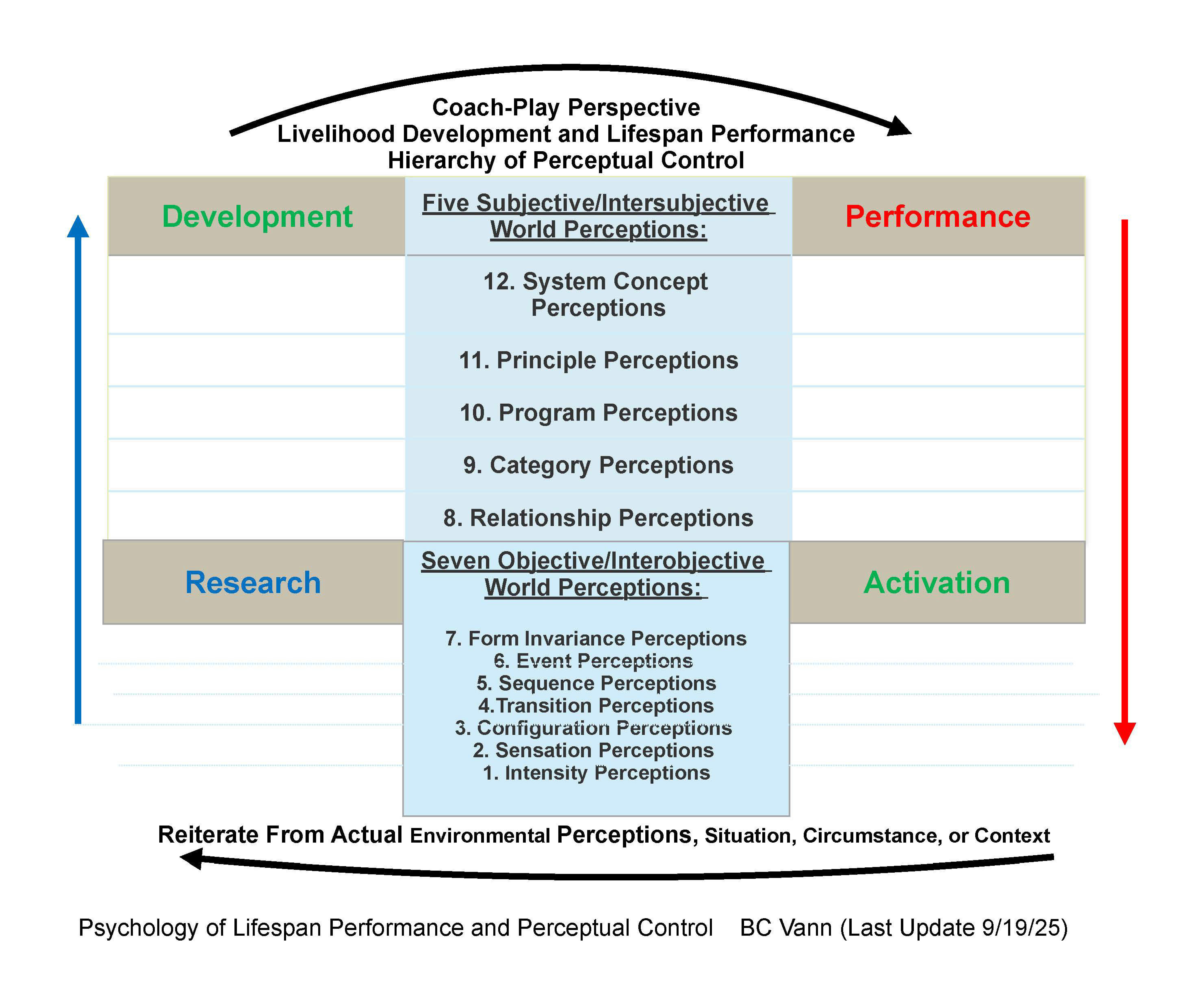
Perceptual Control Theory (PCT) explains why traditional performance management ultimately fails. Behavior is not regulated directly; it emerges from attempts to align perception with internal reference values. When external standards conflict with internal references, individuals experience error. If that error cannot be resolved internally, stress increases. If conflict persists, systems reorganize, often in unintended ways.
LPPC extends this insight across the lifespan, showing that sustainable performance depends on aligning reference values across developmental planes rather than enforcing compliance at the surface. Performance Management attempts to solve performance problems at the wrong level of the system.
Conflict as a Structural Signal
Within Performance Management systems, conflict is often treated as a personal failing, a lack of discipline, a poor attitude, or resistance to change. From a World perspective, conflict is a structural signal. It indicates incompatible reference values operating within the same control hierarchy.
No amount of behavioral enforcement resolves reference conflict. Only reorganization, through dialogue, reflection, and developmental inquiry, can restore coherence. Traditional Performance Management lacks the tools to address this.
Plane Imbalance
Traditional Performance Management (1) overemphasizes the material–sensory plane: metrics, procedures, and outputs dominate attention. The (2) relational–emotional plane is treated instrumentally: motivation is managed through incentives, morale through messaging. The (3) symbolic–causal plane remains implicit: purpose is assumed rather than examined, meaning is subordinated to results.
This imbalance allows systems to function mechanically while undermining long-term development.
Why It Persists
Despite its limitations, Performance Management persists because it is easy to teach, measure, and enforce.
It produces visible order quickly and scales well. For organizations under pressure, these benefits are difficult to relinquish. Performance Management does not fail immediately. It fails developmentally when individuals outgrow the system’s assumptions.
Reflection Prompt
Recall a performance environment you have experienced that relied heavily on standards and metrics. Notice where compliance was achieved and where understanding, responsibility, or adaptability were missing.
That gap marks the limit of Performance Management.
Back To: Beyond Ordinary Coaching
Author Bio

Bruce Vann is a retired USBC silver-level coach and certified corporate performance coach who uses bowling as a lens for lifelong human development. His work draws on decades of experience in athletics, competitive bowling, mentoring, and coaching, including league, tournament, and the West Coast senior tour. Honor scores: 300 game and 834 series. He publishes his methods and ideologies in human development on OptimaBowling.com. The work began with a question he asked in 1968 that still guides him today: What the hell is wrong with this crazy world of ours?
See More: About-Me